We mapped a major app. Here is everything it emits.

Observed on a real device, a major mainstream French app contacts a series of ad networks and measurement tools while running, and a single player, Google AdMob, dominates the traffic. Three requests read as they leave the device show an attribution event, a measurement tool stacking several persistent identifiers, and the device entering a real-time ad auction.
Everyone talks about what apps collect. We measure it. On a real device, in real conditions, with advanced techniques, our engine observes what an app actually transmits once running: which data leaves, and to whom. Here is an extract, on a major mainstream app, fully anonymised.
The publisher’s shared responsibility
Regulators are explicit: a publisher carries at least joint responsibility for the trackers embedded through a third-party SDK. Choosing to integrate an ad network means answering for what it collects.
In other words, the declared list is not enough. What binds the publisher is not the announced set of partners, but what the app actually transmits. That is exactly what we measure.
The traffic, observed while the app runs
In a few dozen seconds of ordinary use, on a physical device, the app contacted fifty distinct hosts and emitted over one hundred and forty requests to third parties.
These third parties fall into a few families: marketing attribution, audience measurement, ad networks and real-time bidding, diagnostics. Here are the main ones, observed being contacted during the run.
Adjust            · marketing attribution
AT Internet       · audience measurement
AppNexus          · ad auctions
Smart             · advertising
Google AdMob      · advertising
Google Tag Manager· tag orchestration
Batch             · engagement and push
Google Crashlytics· diagnostics
One player dominates the traffic
Not all requests carry the same weight. In this session, a single ad network concentrates most of the calls to third parties, far ahead of the rest.
Three requests, as they leave the device
Detail is more telling than a count. Here are three requests, anonymised, chosen because they show three different mechanics: attribution, measurement and bidding.
An attribution platform receives what you look at
This request goes to a marketing attribution platform. The role of such a tool: to link an action inside the app, viewing a listing for instance, to an ad campaign. To do that, it needs to know what you do.
So the request carries more than an identifier. It describes the screen viewed in detail: the category, the sub-category, the listing identifier, and even a conversion value. Stitched together over a session, these events draw the precise interest of the device’s owner, and the price range they care about.
POST app.adjust.com/event
Authorization: Signature signature="Tr4wNW…[truncated]"

partner_params:
  Category_name      = « Vehicles »
  Sub_category_name  = « Motorbike gear »
  ListId             = 321…[masked]
  ConversionValue    = 380.0
  app_instance_id    = b1e0e4…[truncated]
android_id           = 3a67…[masked]
app_token            = 3ouw…[truncated]
A measurement tool stacks up identifiers
The same device is tracked by several persistent identifiers in a single audience-measurement call: the advertising identifier and three distinct visitor identifiers sit together in the same payload.
This stacking is not neutral. An advertising identifier can be reset by the user. Proprietary identifiers, on the other hand, persist and make it possible to re-link sessions even after that reset.
POST logws1357.ati-host.net/event
User-Agent: Piano Analytics SDK 3.6.0

events[0].data:
  adv_id                = 48d49bf2-…-…e560c1
  experiment_visitor_id = f9bfeb8c…[truncated]
  secure_instance_id    = 29ee196c-…[truncated]
  rollout_visitor_id    = 61a07ac8-…[truncated]
  marketplace_brand     = [redacted]
  device                = smartphone
The device enters a real-time ad auction
When an ad slot opens, the app broadcasts its context into a programmatic auction. The principle: in a few milliseconds, buyers receive a description of the available space and bid to fill it.
That description includes the package name, the domain, the exact screen and the device characteristics. This is the context that goes up for bid, to many buyers at once.
POST ib.adnxs.com/openrtb2/prebid

imp[0].ext.gpid = « /[redacted]/Android/Homepage/Interstitial/ »
app.name        = [redacted]
app.bundle      = [redacted]
app.domain      = [redacted]
device.ua       = « Mozilla/5.0 (Linux; Android 15) … »
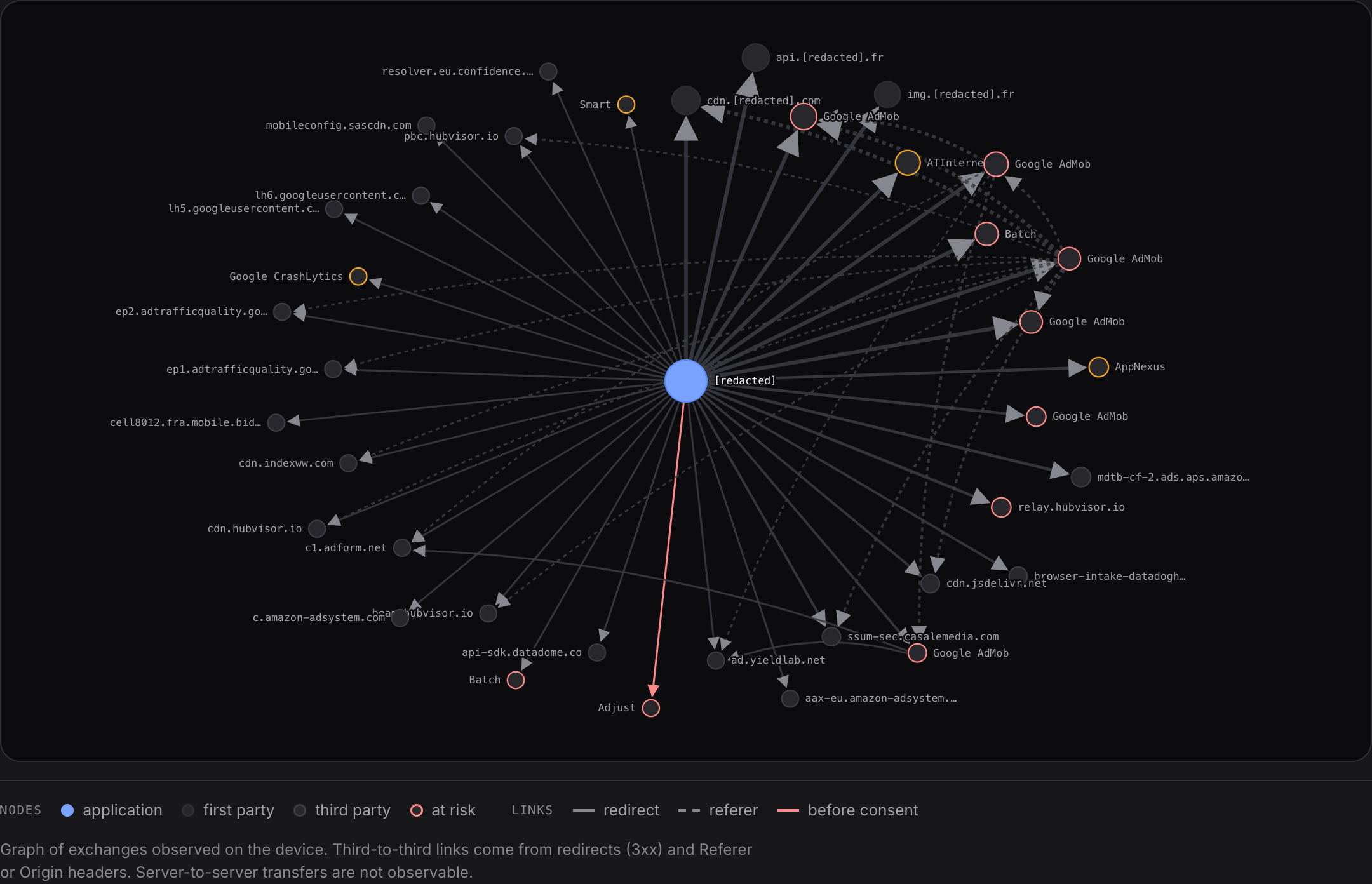
See the structure, not just a list
A list of trackers tells you who is present. It does not tell you how the data moves. This graph shows the real structure of the exchanges observed on the device: what leaves the app directly, and the links between third parties, when one party’s response redirects to another or a header names the originating party.
This is where the publisher’s responsibility sits. A control does not stop at the declared partner list: it looks at what actually leaves, and to whom. A publisher who only sees a flat list misses the relays and the chains; the graph makes them visible, and marks what leaves before any consent.
One honest limit: this graph shows what is observable on the device’s network. Server-to-server exchanges, between the third parties themselves, do not appear. What it does show is measured, not declared.
How to read these signals
Taken in isolation, each field looks harmless. It is their accumulation that draws the profile. An advertising identifier, shared by several third parties, becomes a common key: it links one person’s activity across apps and across ad networks.
Behavioural data, like the category browsed or the price looked at, adds intent. Persistent identifiers add continuity over time. Real-time auctions add broadcast, to many buyers, in an instant. Together, they turn a handful of requests into a portrait.
Why this matters
None of this is theoretical. These extracts come from a real run, on a real phone. It is exactly the level of detail a regulator expects: not the declared list of partners, but what the app actually transmits, to whom, and with what.
It is exactly what Skanopy produces, automatically, from the real traffic, on any Android app. With no configuration and no access to the publisher’s source code, in a single reproducible report. The first step is free: scan your app for trackers from its Google Play link, and receive the list of third parties actually contacted.
Frequently asked questions
By intercepting its exchanges while it runs, then reading the contents of the requests. You find device and advertising identifiers, journey data, sometimes location, and the parameters handed to ad networks. None of it can be read off the screen or the store listing.
Every outbound connection names a domain, and every domain belongs to an identifiable company. The list of actual recipients almost always exceeds the one the privacy policy announces, because embedded SDKs contact their own partners without the publisher deciding request by request.